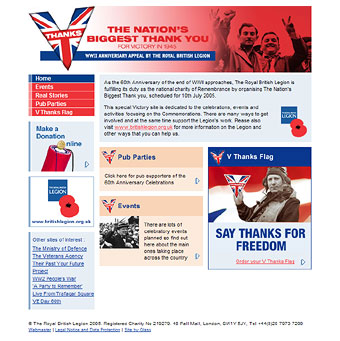
 The Victory Thanks home page.
Eleventy in a Box
A premium Eleventy starter kit for designers and developers who want to spend less time setting up the same project structure and more time designing websites.
Travelling around the London Underground, it is difficult not to notice a series of posters for the British Legion’s Victory Thanks campaign. Among all the advertising for theatres and stores, these Victory Thanks posters stand out as striking and evocative.
Travelling around the London Underground, it is difficult not to notice a series of posters for the British Legion’s Victory Thanks campaign. Among all the advertising for theatres and stores, these Victory Thanks posters stand out as striking and evocative.
When I returned home to North Wales I found more of the posters adorning bus shelters in our local town centre and I imagine that they can be seen across the UK, raising awareness of the work of the British Legion in supporting former servicemen and their families. Particularly as this July is the 60th anniversary of the end of World War 2 in Europe. With the web now an integral part of awareness and fund raising for charities, I hurried over to the Victory Thanks campaign web site to see if the evocative nature of the posters’ design had been transferred successfully to the web.
Sadly I was a little under whelmed.
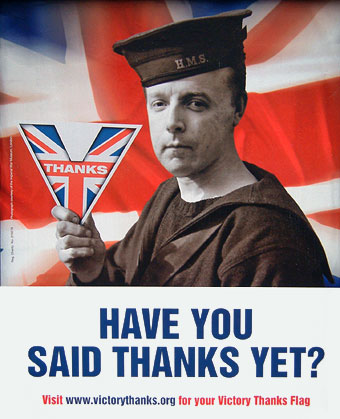
What initially appealed to me about the Victory Thanks posters was their honest simplicity. The combination of Union Flag colours with monochromatic images is both instantly eye-catching and at the same time conveys a subtle nostalgia. Unoriginal? Yes. Stereotypical? Possibly. But effective none-the-less.
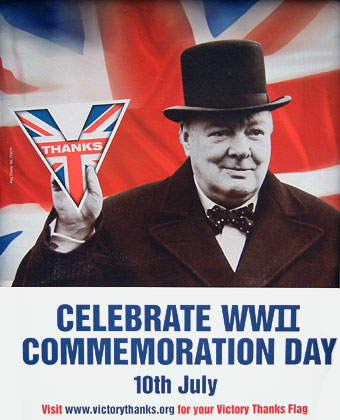
The simple typography and (in the case of the soldiers’ posters) a personal appeal to the viewer adds to the powerful message. Have you said thanks yet?
My apologies to the guys at design agency Glass, but the web site conveys little passion. Absent are any of the feelings evoked by the powerful poster imagery and with them goes any urgency on the part of the viewer to contribute by supporting the campaign.
I feel that the site misses an opportunity to educate and inform the viewer as to the work of the Legion and the plight of former servicemen. Although the site does contain a real stories page, its content lacks depth. Considering the sacrifices made by the men featured and the stories of their wartime experiences, little of these experiences comes across and this I feel is a wasted opportunity. How fantastic it would be to read more about their personal experiences, perhaps in a wider historical context and with photographs, maps or other multimedia presentations. How fantastic it would be to be able to say Thanks
on the site, perhaps through a moderated blog?
The site also fails to maximise the opportunities for donations and online sales from within the context of the content. It makes a common usability error by not placing a direct call to action on the real stories page. The homepage too lacks both visual and task focus. Compare this homepage with the clear and simple educate to sign-up process of the Blogger homepage.
All in all, I am saddened and disappointed at what I feel have been a series of missed opportunities for what I believe could have been a fantastically interesting and persuasive site.
Much of what we read about today in the web development industry revolves around standards, accessibility and usability. But none of these topics can help a site succeed without a design or content which creates an emotional response in a visitor. Too often I feel we concentrate on the technical to the detriment of the emotional. The terms we often use are also cold and unemotional;
Accessibility: Do we want our visitors to simple access our sites or do we want them to engage with, or participate in them? User centred design: Users? Whatever happened to people?
I sincerely hope that our conversations can expand to include the emotional aspects of our craft. To take all that we have learned about the technical and bring that into creating sites with real emotional appeal. I think that when that happens we will have succeeded in reaching another level in the maturing of the web.
Thoughts?
#1 On June 30, 2005 12:45 AM nortypig said:
Perhaps this could be a Malarkey free job?? Or you could contribute some of your expertise to the Glass team in a redevelopment project… it’d be worth more to them than cash.
Understandably you’re busy but I can see you’ve got a social conscience and many people forget the amount of lives given defending Europe in WWII. I used to garden for a Scottish Battle of Britain pilot when I was a teenager and he told the best stories. But I saw a lot of people just dismissed them…
Anyway maybe someone could step in and relight that candle a bit on a redesign project…. perhaps…
#2 On June 30, 2005 02:52 AM Matt Robin said:
Andy: Too true mate!
There’s a growing trend fundemental web design principles being referred to in a very clinical in an effort to almost give them more professional credibility. I think this might stem from the fusion of web designers Vs. web developers (who might be closely associated with a programming background - how clinical can you get?!) I believe the best web designers on the planet right now are the ones who have already recognised this and do realise that the web also has real humans (and their emotions) using the media in so many different ways. I could name individuals - but you already know who they are!The keyword in your comment is ’engage’ - and people engaging with the web rather than just merely accessing it. The most successful web sites maintain the ability to engage a visitors attention and focus (hopefully on some sort of emotional level…and when I mean ’emotional’ - I don’t mean like hysterical-emotional!) Sites need to embrace that in their design values if they want to make their efforts really worthwhile.
I hope the Victory Thanks page can address the points you’ve identified and I wish their worthy campaign every success.
#3 On June 30, 2005 08:41 AM mearso said:
This site struck me as a good example of letting the emotional content of the subject come to the fore.
The large portraits and people’s own words are very direct and set up a relatonship with the viewer, where one wants to know and understand the stories
#4 On June 30, 2005 01:51 PM Richard Rutter said:
A while ago, I talked about my visit to the US National D-Day Museum in New Orleans. Along the way I hinted at disappointment with the Victory Thanks website.
The museum gets everything right that the Victory Thanks site misses out on: it concentrates on telling how the war (in the Pacific) came about, using propaganda of the day to explain the clash of cultures between America and Japan. The day-to-day reality of the war on both sides is illustrated by audio interviews with survivors, graphics detailing the many huge sea battles, video explaining turning points in the war, displays of weapons, clothing and hardware.
The D-Day museum does a fabulous job that any war or historical website could do well to learn from (although its own website does little to convey the atmosphere of the museum itself).
#5 On July 5, 2005 07:23 PM Jo said:
Why dont you offer to redesign their site, for a small fee or free.
This would be a great gesture.It is up to you to contact them …

I’m Andy Clarke. I’ve spent over thirty years helping clients create memorable websites. I’m also the author of five books on web design.
Planning a new website? I’d love to help you create something memorable.
A premium Eleventy starter kit for designers and developers who want to spend less time setting up the same project structure and more time designing websites.
Contract Killer is plain and simple and there’s no legal jargon. It’s customisable to suit your business and has been used on countless web projects since 2008.
Free compound grid and modular grid layout generators, plus a set of HTML/CSS layout templates you can call on to make more interesting layouts, available to buy.