Eleventy in a Box
A premium Eleventy starter kit for designers and developers who want to spend less time setting up the same project structure and more time designing websites.
At the beginning of last month I advocated a quiet revolution and wrote, Fighting a solitary campaign for standards within any organisation must lead inevitably to frustration if the responses are either negative or apathetic.
At the beginning of last month I advocated a quiet revolution and wrote, Fighting a solitary campaign for standards within any organisation must lead inevitably to frustration if the responses are either negative or apathetic. So my advice is to not fight one, but to take the path of quiet revolution. If your manager says But this is a web application, it doesn’t have to be accessible, don’t argue with him but make it accessible anyway.
.
During the month, I spent two very enjoyable learning lunches at the BBC prior to a CSS for Designers workshops. I was impressed by the work of people within the BBC who are not only passionate about standards and accessibility but are pushing them forward at every opportunity.
When reading many of the comments about work featured on sites such as StyleGala or Web Standards Awards, I am often dismayed by criticisms which do not take into account the circumstances under which a site was created. For example in this review of Elan Snowboards awarded by Cam Adams:
Any resemblance between this and a site that supports web standards is purely coincidental.
I love its look, but it otherwise falls short as a symbol of web standards. I think awarded sites should have all their "issues" under control even before being submitted.
One of the many things which I have learned is that it is important to focus on the positive achievements of those implementing standards, often under circumstances which are beyond their total control, such as developing sites within a legacy corporate framework or CMS templates, rather than on the negatives of minor validation errors or global table-based structures. For me, the achievements of these people are far greater than those of us who work in idylic situations where we have complete control of every nuance of design and code.
It was with great joy that I found that the heroes of the quiet revolution at the BBC were already making tremendous efforts to take standards further in their work on new sites, as seen on the landing page for BBC TV.
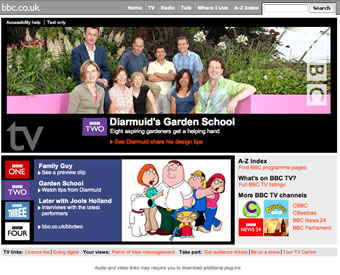
BBC TV is not only a tremendous step forward for standards at the BBC (it features an elastic CSS layout together with Flash and scalable graphics), it also demonstates to me that there are passionate people working hard every day to make standards and accessibility happen, often under their own initiative and often needing to support legacy browsers which some us have the luxury of retiring.
To these heroes of the quiet revolution I say You not only have my admiration, you make me humble
.
#1 On December 3, 2005 04:37 PM Geof Harries said:
Great post. I completely agree with your comment about "those of us who work in idylic situations" - it’s one thing to be your own boss and command nearly every aspect of a web project.
It’s 100% different when you have to jump, or should I say stumble, through ancient corporate hoops to get the job done. When you have to deal with internal agendas and politics that can deride your work, it takes a special type of individual to make it through.
#2 On December 3, 2005 06:30 PM Nathan Smith said:
That’s pretty amazing that the biggest TV station in the UK is advocating web standards. It’s a good sign to me that it will no longer be the geeky exception to the rule, but will just be a normal, expected way for webpages to be designed.
I think Dave Shea said it best on Zen Garden: "More and more major sites are taking the leap, but not enough have. One day this gallery will be a historical curiosity; that day is not today."
While the Zen Garden will probably never be only a "historical curiosity," enough sites have taken the leap that the momentum is carrying itself.
#3 On December 3, 2005 07:35 PM Matt Robin said:
I thoroughly agree Andy: these guys (such as the BBC posse) are doing some great work and it’s really good you’ve highlighted this because I’m sure it’s largely going unrecognised in the web standards community. As discussed with you at the recent ’Geek Dinner’ event in London - the first thought I had about the BBC websites stems from their main site (and good as it is…it’s not as web standards based as it should be) so it’s refreshing to hear that some of the BBC staff are pioneering web standards on some of the associated sites for the BBC as a whole….that’s fantastic! :)
Maybe one day BBC.co.uk will be fully web-standards based (It’s not quite there yet Nathan).
The BBC example is a good one, but also the tip of the iceberg as so many other organisations across the UK have designers who are faced with too much red-tape and outdated systems…but…hey I’m already saying something you already know!
#4 On December 4, 2005 05:46 PM Marc McHale said:
What about when you are in the position of being able to make a fuss? I say make one!! Shout good and load and repeat many times if needed.
a) Its good therapy
and
b) Some people just dont get it the first time.
I am in a fortunate position of being able to influence some of those ancient corporate hoops you mention. Its amazing how many people who have been in the game a long time didnt realise th simple benifits following standards will bring, especially in a prehistoric public sector.
Long live the quiet revoultion, but when you get a chance make a noise and make sure everyone hears you!
Marc
#5 On December 5, 2005 02:33 AM Chris Lienert said:
Awww… now I feel all warm and fuzzy!
#6 On December 5, 2005 09:22 AM simon r jones said:
Well done BBC. I agree its important to remember the circumstances of design, companies like the BBC and Elan Snowboards need to be encouraged not criticised when they take the leap to standards (unless they completely miss the point). Standards code may not always be perfect, but we can all learn. Just have to step onboard first!
si
#7 On December 7, 2005 10:10 AM James Newbery said:
This reminds me of similar discussions about advocating user-centered design methods. The benefits of web standards are similar in many ways to the benefits of user-centered design. Equally, the barriers to getting them into an organisation’s working practices are often similar: misconceptions about cost, lack of understanding of the benefits, resistance to change, etc.
Usability types have tried overcoming these barriers by evangelising heavily, or by using low-cost, low-impact guerilla usability methods. The best method is probably to combine these.
I think I might have created a new job title for myself. I am now a Guerilla Standards Developer. I shall be wearing black combats and a balaclava to work tomorrow.

I’m Andy Clarke. I’ve spent over thirty years helping clients create memorable websites. I’m also the author of five books on web design.
Planning a new website? I’d love to help you create something memorable.
A premium Eleventy starter kit for designers and developers who want to spend less time setting up the same project structure and more time designing websites.
Contract Killer is plain and simple and there’s no legal jargon. It’s customisable to suit your business and has been used on countless web projects since 2008.
Free compound grid and modular grid layout generators, plus a set of HTML/CSS layout templates you can call on to make more interesting layouts, available to buy.