Eleventy in a Box
A premium Eleventy starter kit for designers and developers who want to spend less time setting up the same project structure and more time designing websites.
For years, I said that one day, when I could, I’d buy the camera that played such a big part in my early career. After 35 years or so, this Sinar P2 5x4” camera is finally mine.
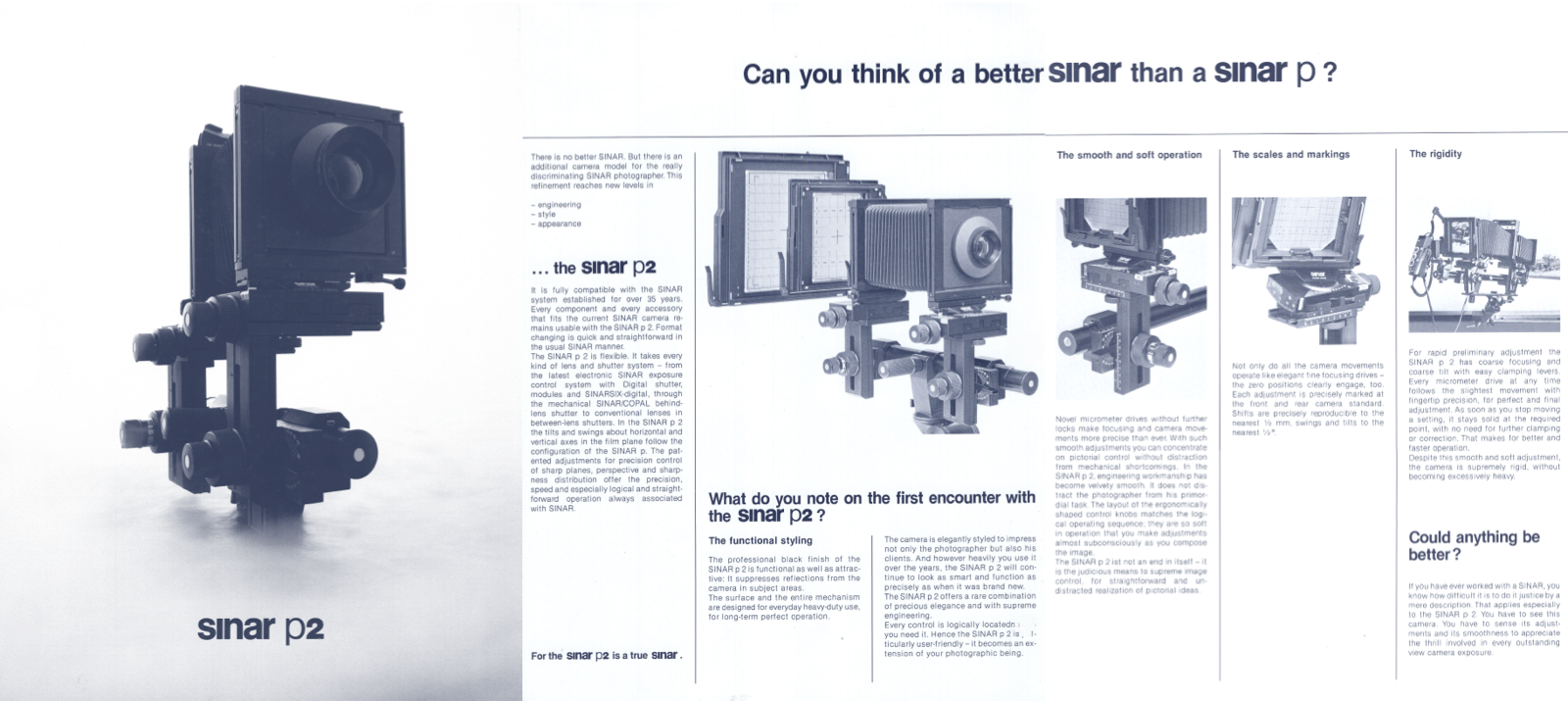
For professional studio photographers, the large-format Sinar P and, later, the P2 view camera were tools used every day. I knew car photographers who used them, others who shot interiors and room sets, and those who photographed pack shots and products. When I sold them from the late ’80s into the ’90s, my customers loved their Sinar cameras.
With the exception of the short-lived, computer-aided Sinar e, the P2 sat at the top of the Sinar range. It was a precision instrument, designed and built unlike any other view camera.
It had a price tag to match. In 1991, the base model P2 5x4 cost $6,390 or £4,785. In today’s money, that’s a little over £13,000. Add accessories like an external shutter, extension rails, lens hoods, and a reflex magnifier, plus lenses, and you’d see little change from what would be £20,000 today.
The Sinar F and later F2 cameras were cheaper, lighter, and better suited to use outside the studio. They were also compatible with every part of Sinar’s modular system. But for me, the P2 was the quintessential and ultimate Sinar.
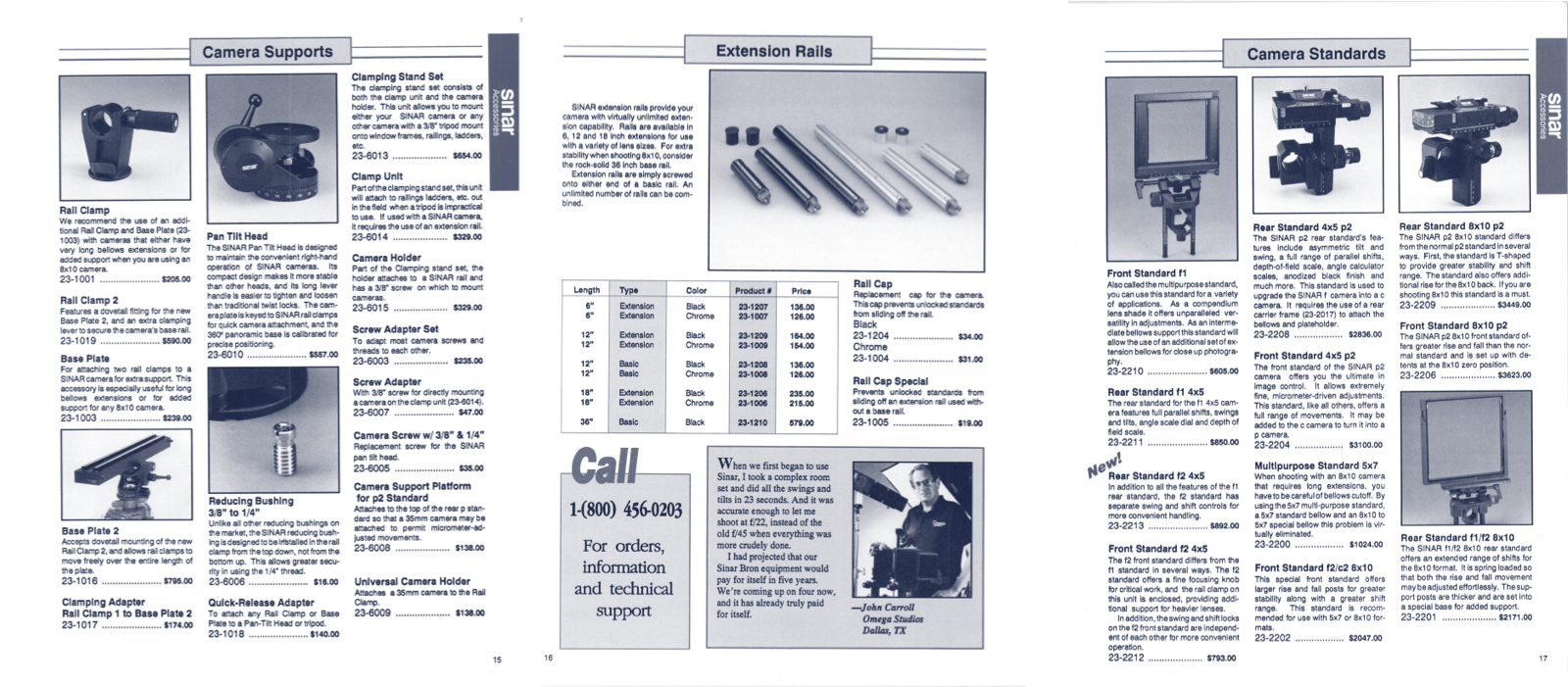
Large-format—or view—cameras differ from fixed-plane cameras like medium-format or SLRs because the front standard, where the lens sits, and the rear standard, where the film or digital sensor lives, can move up and down, left and right, and swing and tilt. Those movements let photographers shift the plane of focus, keep verticals straight, and control perspective in ways fixed cameras can’t. While other camera systems moved around the centre or bottom of the film and lens planes, Sinar had asymmetric movements, which gave photographers more accurate control.
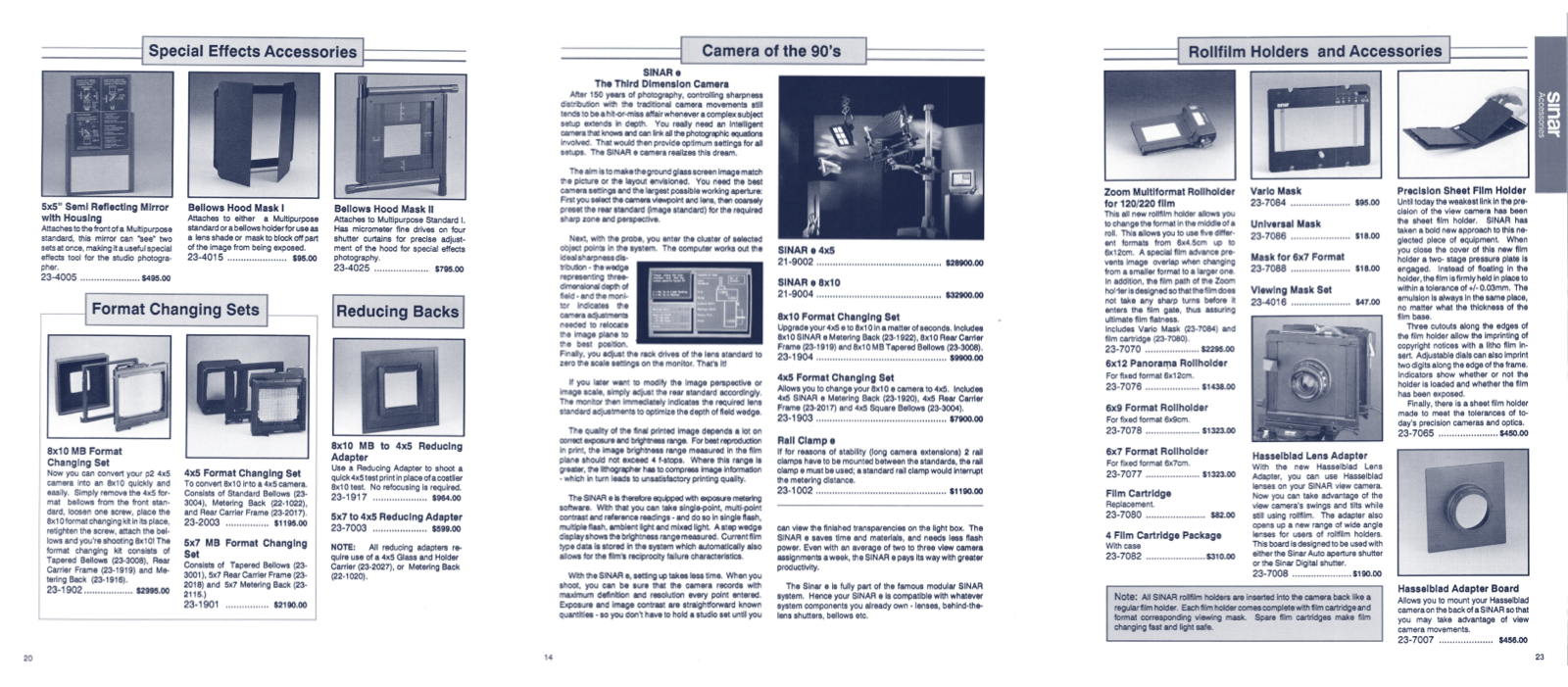
I sold Sinar cameras between 1989 and 1997, first for The Studio Workshop. Working with them took me on my first trips to Schaffhausen in northern Switzerland, for sales conferences and training on new products. Schaffhausen was where I first saw IWC watches and developed a taste for Mary Long cigarettes. When people from the Sinar factory came to the UK, they would bring me a carton. I got to know and admire the people at Sinar very much. Hans Carl Koch could switch between a dozen languages fluently, and Rudi Brutsch was a big man with a bigger personality. I liked them both enormously.
After the introduction of digital backs in the mid-1990s, I joined Silicon Imaging. Digital backs were mostly used on medium-format cameras, including Fuji and Hasselblad, but these lacked the camera movements that were so important to studio photographers. So, I introduced the company to Sinar, and over the next few years we developed an even deeper relationship, this time with Carl Jurg Koch, Hans Carl’s son and the great-grandson of the company’s founder.
The essence of the Sinar system is its modularity. Every part fits every camera. When Sinar became serious about digital photography, they made adapters which fitted first Scitex/Leaf, then their own range of digital camera backs. But at the centre of the Sinar system was always the P2. It could take a 10x8” film back or a digital CCD sensor. You could use it with lenses made a hundred years ago, or the higher-resolution optics needed for digital photography. It used the same camera movements whether you were shooting sheet film, roll film, or digital. It was the best, and I loved it.
I stepped away from the photographic industry in 1998, although I stayed involved with digital photography for a few more years. But I never forgot about the P2 and frequently said that when I could, I would buy one. Not to use as a tool, but as an object that would remind me of the adventures it took me on.
A few weeks ago, during a visit to Vienna, Alex was walking past a camera shop. She called me, excited, moments later. “Is this what I think it is?” It was. A Sinar P2 in mint condition. The shop was closed, but after the weekend I called to get some background on the camera and find out which accessories were included in the €1,300 price.
Two weeks later, the camera arrived at Alex’s apartment. Opening the box was like starting a time capsule. As I put the parts together, I explained to Alex how everything worked. Memories of how to use it came flooding back, along with memories of the places and people the P2 had introduced me to.
Kevin Turner, a gruff Mancunian who taught me that “a deal’s not done ’til the cheque’s stopped bouncing,” and others at The Studio Workshop. Hans Carl Koch and Rudi Brutsch at Sinar. Jo Simons at Silicon Imaging, who still inspires and motivates me and often makes me ask “what would Jo do in that situation?” Then there are the photographers I met, and the heads of companies like Avon, Christie’s, Dixons, Tesco, and more. None of these connections would have happened if it wasn’t for the P2.
I needed a lens, a tripod, plus a few accessories to complete my ideal P2 configuration. Items in as good condition as my camera are hard to find, but I now have a binocular magnifier, a vintage FOBA tripod, and a 90mm lens. A friend came over today, and we put everything together again while I happily explained the camera and what it means to me.
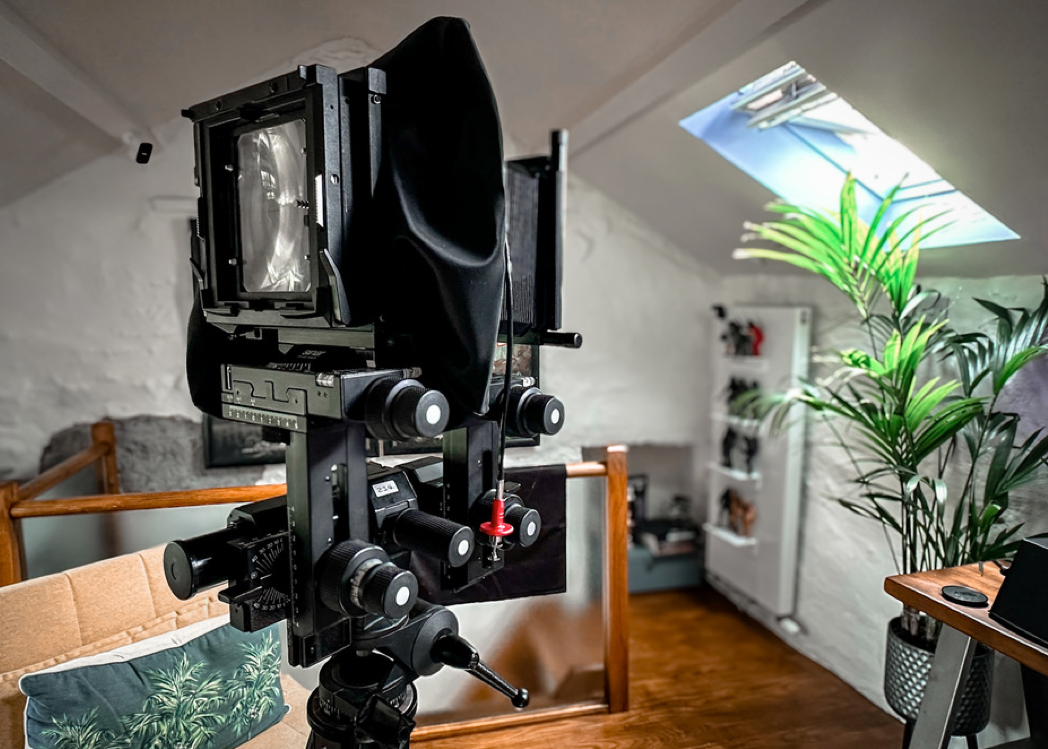
I’ll look at this camera every day and remember the adventures it took me on, the places it sent me, and the people it brought into my life.

I’m Andy Clarke. I’ve spent over thirty years helping clients create memorable websites. I’m also the author of five books on web design.
Planning a new website? I’d love to help you create something memorable.
A premium Eleventy starter kit for designers and developers who want to spend less time setting up the same project structure and more time designing websites.
Contract Killer is plain and simple and there’s no legal jargon. It’s customisable to suit your business and has been used on countless web projects since 2008.
Free compound grid and modular grid layout generators, plus a set of HTML/CSS layout templates you can call on to make more interesting layouts, available to buy.