When layouts affect book editing
While designing the PDF version of Standout Designs for the Web, I discovered that spreads can make parts of my manuscript redundant. But those words can still matter in a reflowable ebook. So I’m editing one book in two different ways.
I’ve been spending the past few weeks turning the manuscript for Standout Designs for the Web into an actual book. I’m designing the print edition in InDesign while, at the same time, preparing a reflowable EPUB version from my original Markdown.
I expected the two versions would need slightly different treatments, as a press-ready PDF needs high-resolution images, while the ebook needs them optimised. What I hadn’t appreciated was that I might need to edit the text itself between versions, so that there’d be one edit for PDF spreads and another for an ebook’s reading flow.
I finished writing Standout Designs for the Web before I started designing it. I’d already edited every chapter several times, so when I imported the text into InDesign, I thought the editing was done. Oh, how wrong that turned out to be.
In InDesign, sometimes a paragraph left an awkward amount of space at the bottom of a page. Occasionally, taking out a sentence prevented another paragraph from spilling onto the next spread. I didn’t mind making those cuts too much, even though I’d spent so much time polishing the manuscript.
But when I started adding illustrations and designing the spreads, I realised some of my words were no longer necessary because illustrations were doing their job. For example, in the chapter on layout, I describe how modular grids can alter how quickly someone moves across a page. In the manuscript, I needed words to explain this, but in the PDF, examples sit alongside the text, making some of my explanations redundant.
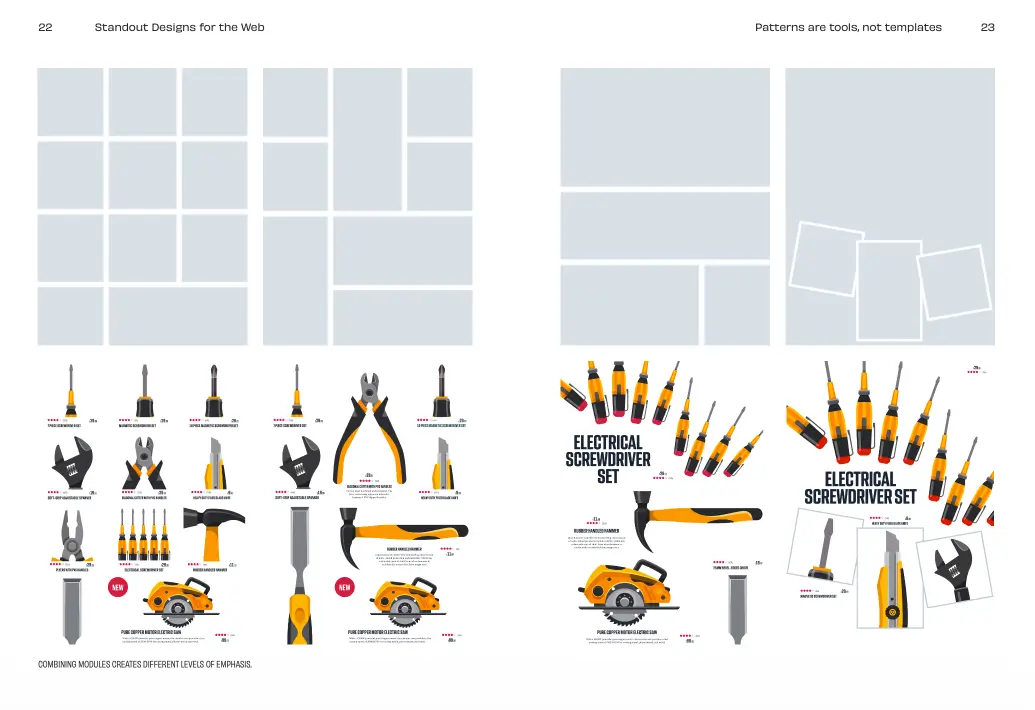
Later, I explain how compound grids can provide an underlying structure that can accommodate different page types without making them look the same. But when those designs are arranged together on a spread, the result is obvious.
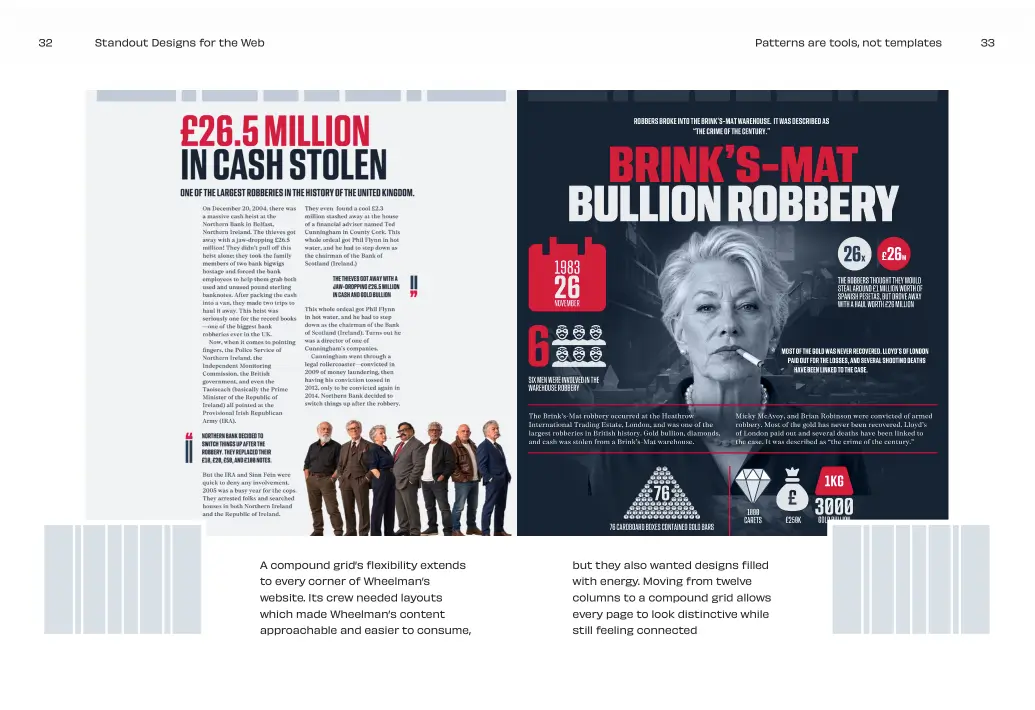
In the PDF, I know that two pages will appear together, so I can introduce an idea on the left and demonstrate it on the right. I can put two examples side by side so someone can compare them. I can make an image enormous when I want someone to stop and look at it, or make a sequence smaller to quicken the pace. In that way, designing the spread is as much a part of the content as the writing. But the ebook is different.
Alongside the PDF, I’ve been working on a reflowable EPUB version. My source files are Markdown, which Codex transforms into semantic HTML before packaging the chapters, styles, fonts, and images into an ebook. Ebooks reflow, which gives readers much more control over how those elements look.
I read ebooks on my iPad and MacBook Pro in landscape, but someone might use a phone in portrait, or a dedicated ebook reader. They might increase the type size or choose a different typeface.
In an ebook, a paragraph that appears alongside an illustration in a PDF might appear above or below it. A comparison that’s spread across two facing pages in a PDF might become a sequence of images separated by text. So I can’t depend on composition to communicate in quite the same way. Some of the sentences I’d cut from the PDF can become useful again. I decided to treat my original Markdown manuscript as the basis for the ebook, meaning the same book has two different edits, depending on the output.
I’m comfortable with that because it’s the same book, making the same arguments and teaching the same ideas. I’m just editing it differently for different reading experiences—designing Standout Designs for the Web for where people read it—rather than trying to squeeze its PDF into an EPUB.
Digital versions of Standout Designs for the Web (PDF and ePUB) will be released on 20th November 2026, with pre-orders starting one week before.
October 5, 2026 • Andy Clarke • Standout Design for the Web